
Founder Sales Fundamentals
A Self-Directed Learning Path for First-Time B2B SaaS Sellers
September 5, 2026 · 13 min read
You changed your discovery questions twice this week because each deal felt different. A first sales rep can't learn the judgment you haven't made visible.
You already have buyer conversations. Some become customers. Others stall after a good demo, and nobody can explain why. Hiring adds another person to that motion. It doesn't define the motion for them.
Learn more about Need help applying the framework to live deals or your team? Work directly with SalesMVP Lab..
A Minimum Viable Sales Process captures the smallest process you can teach, test, and improve. Not enterprise bureaucracy. Just enough structure to qualify deals, run useful calls, and agree on the next step.
Key Takeaways:
- Document buyer decisions, not founder habits.
- Define sales stages through buyer actions.
- Use the FOUNDER Framework across every call.
- Build demos around pain and impact.
- Track where deals lose momentum.
- Coach the process using real calls.
Why Founder Intuition Breaks During the First Sales Hire
Founder intuition breaks during a first sales hire because it contains decisions the founder makes without naming them. A rep can copy your questions, but not the judgment behind when to probe, show a feature, or slow the deal. If that judgment stays hidden, hiring adds capacity before it adds consistency.
Founder Judgment Works Until Someone Else Needs It
Picture Thursday at 10:18 a.m. Your new rep opens HubSpot, joins the Zoom call, and starts asking the discovery questions from your notes. The buyer gives short answers. After eight minutes, the rep launches the demo because that's what you usually do next. The call ends with, "Send me some information."
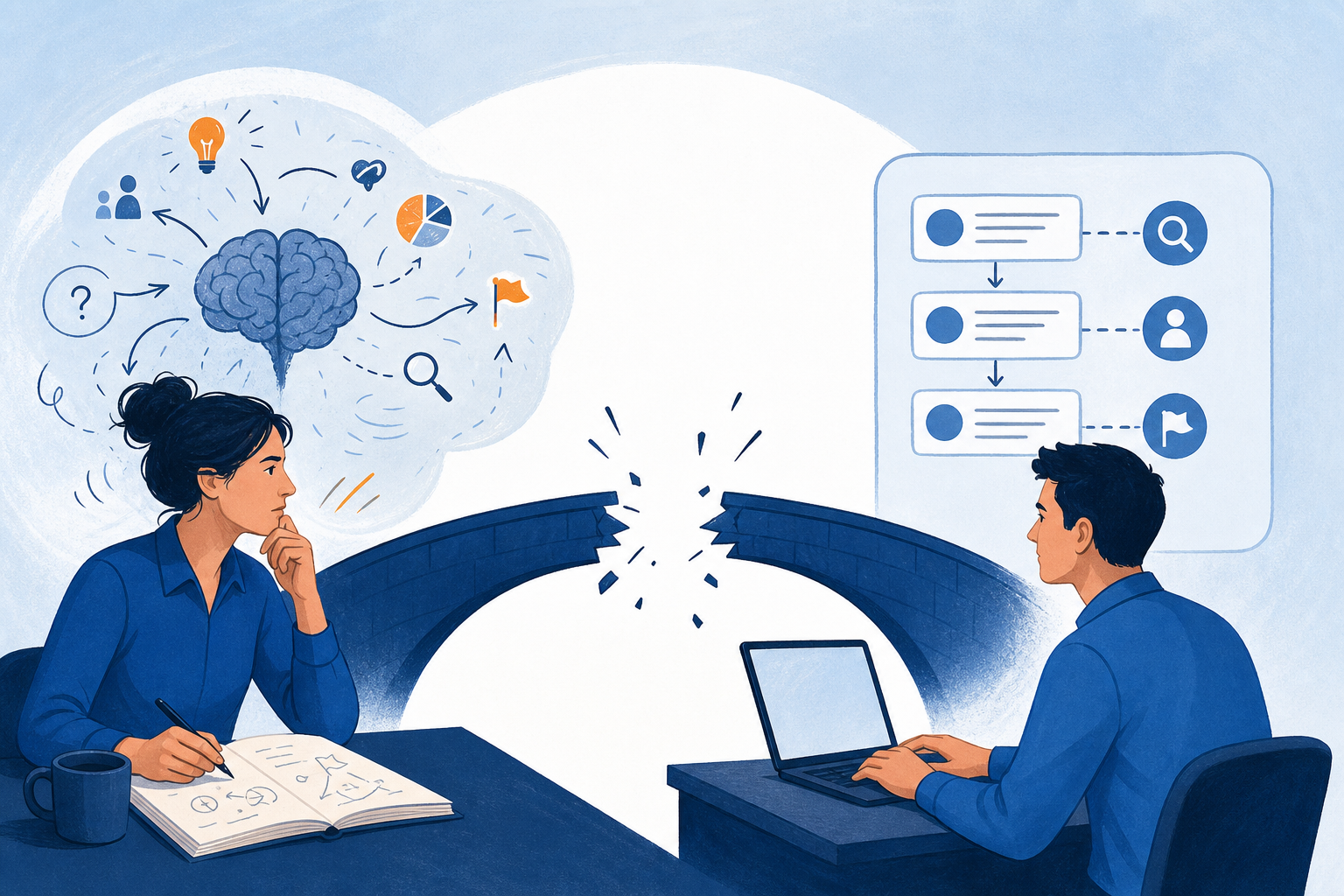
You listen to the recording later. The rep missed the business impact, the driving event, and the person who approves the purchase. Your feedback is accurate: "You needed to go deeper." It's also almost useless. Go deeper where?
Hidden Judgment Creates Moving Expectations
That judgment resembles production code with no documentation or tests. You've heard the objections, watched buyers react, and learned when a technical detail matters. It may work under your control, but nobody else can safely change or repeat it. Every edit risks breaking something only you understand.
That's why hiring can create frustration on both sides. You think the rep lacks instinct. The rep thinks your expectations move after every call. Neither person has a shared definition of good sales execution.
Features Don't Differentiate Without Buyer Context
A capability becomes meaningful only when it connects to an outcome, a problem the buyer cares about, and a reason to act. Features aren't differentiation on their own. Without those links, your demo becomes a product tour with nicer wording.
Consider an integration that saves customer-success leaders from copying data between systems. The integration matters because it removes manual work. That saved time may let the team review more customer feedback, respond faster, or avoid another hire. Different buyers will care about different outcomes.
The chain matters:
- Feature: What the product can do.
- Capability: What the buyer can now do.
- Business impact: What changes in the company.
- Negative consequence: What continues without the change.
- Buyer context: Who cares enough to support the decision.
A B2B SaaS feedback company changed its discovery and follow-up around that chain. Demos moved away from broad feature coverage and toward the business impact buyers had already discussed. Over four months, the company increased MRR by 37%.
One sales change never explains every dollar of growth. Product, market timing, pipeline, and execution still matter. The useful lesson is narrower: clearer discovery gave the demo a job. It showed how the product solved a problem the buyer had already agreed was worth fixing.
Your first sales rep needs that logic before they need more talk tracks. The next job is turning those decisions into the smallest process they can learn.
How to Build a Minimum Viable Sales Process Reps Can Learn
A Minimum Viable Sales Process gives the founder and first sales rep a shared way to qualify, advance, and learn from deals. It documents the few decisions that matter across the buying journey. Start small, then improve the process using call evidence and conversion data.
Can You Explain the Motion Without Telling a Story?
Can you explain how a deal moves without retelling your last successful sale? Founders often describe sales through anecdotes: "I knew they were serious," or "The demo just clicked." Those statements may be true. They don't tell a rep what evidence to find.
Before hiring, write down what should happen from first conversation through decision. Keep it to one page at first. If the document needs twenty pages, you're probably documenting every possible exception instead of the core motion. Exceptions belong in coaching.
Test your current process with five questions:
- What facts make an opportunity worth pursuing?
- What buyer problem must be confirmed before a demo?
- What buyer action moves the deal into each stage?
- What evidence shows urgency is real?
- Who needs to participate before a purchase decision?
Here's the scoring rule. If you can answer four or five clearly, you have something to refine. If you can answer three or fewer, keep the founder close to calls while you document the missing decisions. Asking a rep to fill every gap creates a sales-process experiment, not a fair ramp plan.
Define Stages Through Buyer Actions
Seller activity is easy to log. Buyer commitment is what makes the pipeline real. A stage named "Demo" tells you what the seller did. It says nothing about whether the buyer understood the value, involved the right people, or agreed to continue.
Define each stage with an observable exit condition. A discovery call isn't complete because the meeting ended. It's complete when you understand the buyer's problem, expected impact, current approach, and decision context well enough to decide whether another call makes sense.
A simple early-stage process might use these exit conditions:
- Qualified: The buyer confirmed a relevant problem and agreed it deserves attention.
- Demo complete: The buyer connected shown capabilities to an agreed business outcome.
- Proposal review: The buyer reviewed scope, commercial terms, and open concerns with you.
- Decision: The required people completed their evaluation and named what happens next.
Your process may need a trial, security review, or implementation call. Fair enough. Add those when the buying process requires them, not because another SaaS company has them in its CRM.
One rule keeps the process honest: no buyer action, no stage change. A sent proposal isn't progress if the buyer hasn't agreed to review it. That rule will make your pipeline smaller. It will also make pipeline review far more useful.
Use the FOUNDER Framework Across the Whole Deal
Discovery shouldn't end after the first call. Buyers reveal context over time, especially when new stakeholders join or priorities change. The FOUNDER Framework gives you a shared set of buyer questions to revisit without turning each conversation into an interrogation.
Start with Facts, then understand Objectives and Pain. Uncover the business Impact and clarify the Negative Consequences of leaving the problem alone. Find the Driving Event behind the timing. Finally, learn how the buyer is Reaching a Decision.
Each element changes what you do next:
- Facts: Confirm the environment, people, current tools, and constraints.
- Objectives and Pain: Define the desired change and what blocks it.
- Uncovering Impact: Connect the problem to money, time, risk, or customer outcomes.
- Negative Consequences: Clarify what happens if nothing changes.
- Driving Events: Identify the deadline or trigger behind action.
- Reaching a Decision: Map criteria, process, budget, and people involved.
Scripts can help a new rep remember questions. That's a real benefit. A script still can't decide which answer deserves another question, when a claim needs proof, or whether the buyer has enough urgency to move. Framework first. Script second.
Use one practical rule during deal review. If the demo introduces pain that never appeared in discovery, stop and verify it. If nobody can name a driving event, treat the timing as unproven rather than writing a hopeful close date.
For structured practice across those six elements, start with the Founder-Led Revenue Path on Caliber, including Daniel Hebert's Foundations of Founder-Led Sales. Daniel contributes the course as an instructor, while Caliber provides the external learning platform.
Build Demos From Problems, Not Navigation
A feature tour displays the product. A useful demo proves that the product can address the buyer's stated problem. The difference starts before anyone shares a screen.
Limit the demo to three or four chapters. Each chapter should connect one problem to one capability, then invite the buyer to respond. If a chapter doesn't map to discovery, remove it or ask why it belongs.
Structure each chapter in four parts:
- Problem: Restate the issue in the buyer's language.
- Solution: Explain your approach before showing the interface.
- Show: Demonstrate only the capability connected to that issue.
- Ask: Invite the buyer to compare it with their current approach.
Keep each chapter between one and three minutes of screen time. Ten uninterrupted minutes is usually plenty. More product rarely creates more value because the buyer must translate every feature back into their world.
Technical depth has a place. If the buyer asks about architecture, security, or implementation, answer the question. The mistake is giving that detail before you know it affects the decision. Relevance earns attention.
End each chapter with a question that tests your understanding. "Would that change how your team handles the handoff?" gives you useful evidence. "Does that make sense?" usually earns a polite yes and nothing more.
Close the Loop With Next Steps and Metrics
A strong call can still produce a weak deal if nobody owns what happens next. Founders often leave next steps until the final minute, then accept "send me something" because the calendar is already flashing red. Momentum needs more care than that.
Reserve the final five to ten minutes for the buying process. Confirm what the buyer needs to evaluate, who else should join, and what decision the next meeting should support. Then assign one action to the buyer and one to the seller, both with dates.
A common early SaaS flow uses four calls:
- Intro and discovery: Confirm fit, pain, impact, and the reason for change.
- Demo: Show how the product addresses the agreed problems.
- Implementation and proposal review: Resolve scope, risk, and practical concerns.
- Pricing and decision: Address final terms and confirm the decision path.
That sequence is a baseline, not a law. Trial-led products may need product usage between calls. Enterprise deals may require security, procurement, and several stakeholder meetings. Preserve the decisions even when the number of calls changes.
Send the recap while the conversation is still fresh, ideally within two hours. Include the problem, expected impact, remaining risks, buyer action, seller action, and next meeting. Write it so your champion can forward it without rewriting your story.
Metrics tell you where the process needs work. Track qualified-opportunity conversion, stage conversion, win rate, sales-cycle length, and the point where deals stop. If three of your last five losses reach demo without a clear driving event, more demo practice probably won't fix the issue. Review discovery first.
Don't redraw the whole process after one strange deal. Review patterns across completed opportunities, then change one behavior or exit condition at a time. You're building the smallest teachable process, not freezing sales forever.
Once the process is visible, the remaining question is how you coach the judgment behind it.
How SalesMVP Lab Turns Call Evidence Into Coaching
Ready to get started? Start with the Founder-Led Revenue Path on Caliber, including Daniel Hebert's Foundations of Founder-Led Sales..
SalesMVP Lab turns a documented process into live coaching and management cadence, not software and not outsourced closing. The work starts with call evidence, deal risk, stage definitions, and current metrics. You get support improving the motion while the founder and rep remain accountable for execution.
Turn Actual Calls Into Specific Practice
Two call reviews can reveal more than another folder of scripts because they show what happened under real pressure. You can hear where the founder accepted a vague answer, where the rep introduced a feature too early, or where nobody confirmed the decision process. Specific moments create specific practice.
In SalesMVP Lab coaching, current calls and opportunities shape what gets reviewed next. Two coaching sessions per month can focus on the deals, process questions, and skills creating the most risk. Founder Enablement adds weekly coaching and call review when the motion needs a tighter learning cycle.
Use Metrics to Choose the Next Change
The monthly sales-metric audit adds another view. If calls sound strong but qualified deals keep stalling after proposals, the issue may sit in stage criteria, commercial review, or follow-through. Light enablement support can then improve the smallest useful asset, such as a demo chapter, recap structure, or discovery prompt.
Coaching doesn't remove founder accountability. You still run the calls, make the decisions, and test the change. Frankly, that's the point. The process becomes yours because you build it through use.
Add Management Before Adding More Scripts
Once a rep joins, the process needs a management rhythm. Weekly pipeline and deal review turns the meeting from a list of updates into decisions about risk, evidence, next actions, and coaching. "What happened?" matters less than "What must we learn or decide next?"
SalesMVP Lab can also provide hands-on sales management when an early team needs regular expectations, performance review, deal coaching, and a working cadence without a full-time sales leader. Company leadership still owns employment decisions and the revenue number. No honest coaching engagement can guarantee closed revenue or forecast accuracy.
For a small team, weekly training and call review should target one or two behaviors at a time. Fixing discovery, demo structure, follow-up, and negotiation in one session creates activity without adoption. Pick the behavior tied to the current breakdown. Then inspect it on the next calls.
If your process exists on paper but falls apart inside current opportunities, work directly with SalesMVP Lab to apply the framework to live deals or your team. Bring one call, one deal, and one decision that needs better evidence.
Your rep still owns execution. Now both of you have something concrete to coach.
Give Your First Sales Rep Something Teachable
A teachable sales process captures the decisions your first sales rep must repeat without pretending every deal will look the same. Define buyer actions, connect features to meaningful outcomes, and inspect the motion using calls and metrics. Keep the process small enough to use every week.
Know What Your Rep Actually Needs
Your first sales hire doesn't need every answer.
Build a Shared Way to Learn
They need a shared way to find answers from calls, deals, and buyer evidence.
Capture It, Test It, Teach It
Capture it, Test it, and Teach it.

About Daniel Hebert
Daniel Hebert is a sales coach, operator, and teacher with 13 years in SaaS. He helps early-stage founders close more of the pipeline they already have, hire and manage their first reps, and build practical sales frameworks their teams can actually use.
Connect with Daniel Hebert on LinkedInFrequently asked questions
How do I create a follow-up email after a sales call?
To craft an effective follow-up email, start by summarizing the key points discussed during the call. Use the FOUNDER Framework to structure your email: 1) Outline the Facts and Objectives discussed, 2) Highlight the Impact and Negative Consequences of not addressing the buyer's pain points, and 3) Define the next steps for both you and the buyer. Send this email within two hours to keep the conversation fresh. This approach helps reinforce your professionalism and keeps the momentum going.
What if my sales rep struggles with discovery calls?
If your sales rep is having trouble with discovery calls, consider using the FOUNDER Framework to guide their conversations. Encourage them to focus on understanding the Facts about the prospect's environment, identifying their Objectives and Pain, and uncovering the Impact of those issues. You can also schedule two coaching sessions per month through SalesMVP Lab to provide direct feedback on their calls and help them refine their skills. This targeted coaching can improve their confidence and effectiveness in discovery.
Can I track my sales process metrics effectively?
Yes, you can track your sales process metrics by conducting a monthly sales-metric audit. This involves reviewing key indicators like qualified-opportunity conversion rates, stage conversion rates, win rates, and sales-cycle length. Use this data to identify where your sales process might be breaking down. If you notice patterns, like deals stalling after proposals, you can then focus on specific areas for improvement. SalesMVP Lab can assist you in analyzing these metrics and providing insights on the next steps.
When should I implement a Minimum Viable Sales Process?
You should implement a Minimum Viable Sales Process when you're ready to scale your sales efforts but want to maintain a manageable structure. Start by documenting the essential buyer actions and defining clear sales stages based on observable exit conditions. This process should be small enough to adapt and refine as you learn from real calls and deals. SalesMVP Lab can help you develop this process and ensure it aligns with how deals actually progress.