

Pipeline Metrics and Forecasting
A Simple Forecasting Method for Founder-Led Sales Teams
August 27, 2026 · 12 min read
TL;DR
To improve forecasting for founder-led sales teams, shift pipeline meetings to focus on decision-making and coaching. Emphasize a structured discovery process, document essential practices, and ensure metrics guide reps to enhance execution and close more deals.
Your 3 reps can hear the same buyer problem and leave with 3 different deals in mind. One sends pricing while another books a second demo. By Friday, both deals land back on your calendar because nobody agreed on the buyer's impact or decision path. You're still the founder, but you've also become the team's default sales manager. A shared deal and coaching cadence is how you stop solving every call yourself.
You feel the cost every week. A rep brings you a stalled deal, the CRM says "proposal," and nobody can explain who approves the purchase or why the buyer needs to act. Now you're back on the call, trying to recover context your process should've captured.
Learn more about Need help applying the framework to live deals or your team? Work directly with SalesMVP Lab..
Key Takeaways:
- Turn pipeline meetings into decision and coaching sessions.
- Treat discovery as a process, not an event.
- Coach one observable behavior at a time.
- Use call evidence and metrics together.
- Document the smallest process a rep can inherit.
- Match outside support to your current management gap.
Why More Pipeline Won't Fix Inconsistent Sales Execution
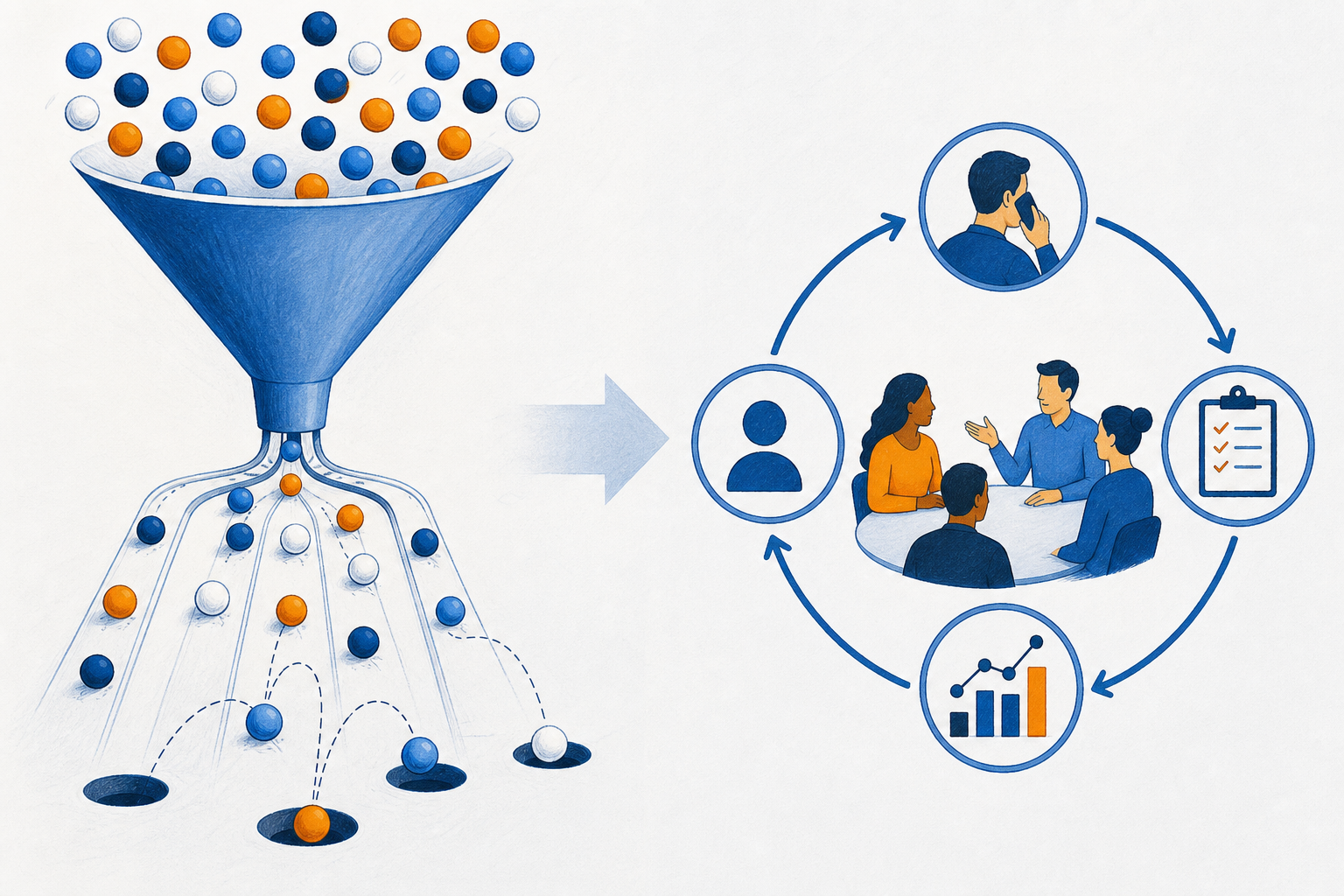
More pipeline gives an inconsistent sales team more chances to repeat the same mistakes. The real constraint is usually the management loop around calls, deals, metrics, and rep development. When that loop is weak, opportunity volume amplifies weak execution rather than fixing it.
Your pipeline meeting is hiding the real problem
"The demo went great," your rep says at Tuesday's 9 a.m. pipeline review. The buyer liked the product, asked about pricing, and promised to speak with finance. You ask what problem finance is being asked to fund. Nobody knows.
Now the meeting turns into an investigation. You ask who else is involved, what happens if the buyer waits, and whether a date is driving the decision. The rep takes notes. Next week, another deal arrives with the same gaps.
Status updates have value. You need to know what changed, what's blocked, and where the forecast moved. That's a fair reason to review the pipeline.
Status alone doesn't improve judgment. If the meeting ends without testing the evidence, deciding what the rep should do, and coaching how they'll do it, you haven't managed the deal. You've narrated the CRM. I've sat through enough of those meetings to know how busy they feel and how little they change.
Discovery gaps compound after the first call
Weak discovery rarely kills a deal during discovery. It shows up later, when the demo becomes a feature tour, the follow-up lacks business impact, and the proposal reaches someone who never joined the earlier calls.
Discovery is a process, not an event. Facts may surface on the first call, and impact may become clear during the demo. The real driving event might not appear until legal, finance, or an executive enters the decision.
A customer-feedback SaaS company had active buyer conversations but struggled to connect pain with business impact. Its demos covered useful features, yet the sales story changed from opportunity to opportunity. After applying a consistent framework across discovery and follow-up, the company reported a 37% increase in MRR over four months.
That outcome doesn't mean a framework guarantees growth. Product fit, pipeline quality, pricing, and market conditions still matter. The useful lesson is narrower: when discovery travels across the buying journey, each conversation builds on evidence rather than starting over. Think of discovery like a relay baton, not a single sprint. Each rep hands the next conversation the context it needs, and the buyer never has to re-run the first leg.
Without that continuity, you become the default sales manager and rescue layer. Every stalled deal lands back on your desk, usually after momentum has faded. The fix starts with a management cadence your reps can run with you, then eventually without you.
How to Build a Sales Management Cadence That Repeats
A repeatable sales cadence connects five things: pipeline, deals, calls, metrics, and coaching. Each part should produce a decision or changed behavior, not another update. Built properly, the cadence gives you visibility while teaching reps how to think through the buying process.
Find where your management loop breaks
Which part of your sales week creates evidence, and which part merely creates activity? A full calendar can hide a broken management loop. Reps attend calls, send follow-ups, and move CRM stages while the buyer's decision remains poorly understood.
Start with the last five deals reviewed by your team. Check whether the same questions were answered in each opportunity. If the evidence changes by rep, you don't have a shared deal process yet.
Founders often diagnose the wrong gap. They see inconsistent win rates and assume the reps need objection handling. Call evidence may show that the real miss happened much earlier, when nobody connected the buyer's problem to cost, risk, or a fixed event.
Use these questions before changing your cadence:
- Can each rep explain the buyer's problem without naming your product?
- Does every active deal have a buyer-owned next action and date?
- Can you name the people involved in the decision?
- Do call reviews produce one behavior to practice?
- Do your metrics change what gets coached next week?
Three or more weak answers point to a management problem, not a motivation problem. Fix the loop before adding training.
Turn pipeline review into a decision meeting
Pipeline review should answer what changed, what evidence supports the stage, and what decision comes next. That sounds basic. It isn't common.
A useful review moves from the buyer backward. Start with the decision they're trying to make, then test whether your team understands the pain, impact, timing, people, and approval path. If the rep can only describe seller activity, the deal isn't as advanced as the CRM suggests.
The founder's job isn't to prescribe every email. Your job is to improve the rep's judgment. Ask what they believe, what evidence supports that belief, and what action would reduce the biggest risk.
Run each opportunity through a consistent sequence:
- Name the buyer's current decision: What are they deciding now?
- Test the evidence: What did the buyer say or do?
- Identify the largest risk: What could stop the deal?
- Choose the next buyer action: What commitment would create progress?
- Coach the rep action: How will the rep ask for it?
If no buyer action exists, don't advance the stage. A sent proposal is seller activity. A scheduled proposal review with the economic buyer is evidence.
This is where a weekly pipeline and deal review helps. With a consistent structure for risk, evidence, next decisions, and rep actions, pipeline meetings stop being status updates and start becoming coaching.
Coach one behavior from real call evidence
One rep loses momentum during discovery because they accept vague pain. Another does solid discovery, then shows twelve features without connecting them to what the buyer said. Giving both reps the same training won't solve either problem.
Review the actual calls. Find the exact moment momentum changed, then isolate the behavior behind it. Maybe the rep moved on before quantifying impact. Maybe they answered a pricing question without first understanding the decision criteria.
Call review can become overly detailed, and that's a real risk. A founder who comments on every phrase creates a rep who waits for correction instead of thinking. Limit each review to one or two behaviors that matter most.
After the review, define the replacement behavior in plain language:
- Ask one follow-up when pain remains vague.
- Repeat the buyer's words before showing a feature.
- Leave five to ten minutes for next steps.
- Confirm the next buyer action and date.
- Write the recap so it can be forwarded internally.
Practice the behavior on the next relevant call. Review it again. Coaching changes execution through repetition, not volume.
That is why weekly coaching and call review works better than generic training. Use current calls and recent deal evidence to choose one behavior, practice it, and inspect it again on the next review.
Make discovery travel across the buying journey
The FOUNDER Framework gives your team shared language for buyer context. It covers Facts, Objectives and Pain, Uncovering Impact, Negative Consequences, Driving Events, and Reaching a Decision. Those elements aren't a script, and they shouldn't be run as a linear interrogation.
Your rep might confirm basic facts on the intro call, uncover impact during a workflow discussion, and learn the real decision process after a new stakeholder joins. Each conversation should fill gaps from the last one. That makes the buyer's decision easier because the team isn't asking them to repeat everything.
A useful deal record should show where each element appears:
- Discovery: Establish facts, objectives, pain, and early impact.
- Demo: Connect relevant capabilities to the stated problem.
- Follow-up: Recap impact, consequences, and agreed actions.
- Proposal review: Confirm decision criteria, people, and approval steps.
- Negotiation: Revisit the driving event and cost of delay.
The goal of sales isn't to pressure the buyer. It's to make a complex decision easier. If your reps need a structured introduction before you build this into team coaching, the Founder-Led Revenue Path on Caliber includes Daniel Hebert's Foundations of Founder-Led Sales. Caliber is the external learning platform, and Daniel contributes as an instructor.
Use metrics to choose the next coaching problem
Metrics tell you where to investigate. Calls tell you why the number moved. Looking at either one alone gives you half a diagnosis.
Suppose demo-to-proposal conversion falls. The metric identifies the stage, but it can't tell you whether reps are showing too much, qualifying too little, or failing to involve the right person. Sample calls from that stage before choosing the coaching topic.
Bad CRM data weakens the exercise. If stages don't have clear exit criteria, conversion rates can reflect rep habits more than buyer progress. Fix the stage definitions before treating the dashboard as evidence.
A practical rule works well: if a metric changes, review representative calls from the affected stage. If calls show a recurring behavior, coach that behavior and watch the metric over the next review period. If the calls don't show a pattern, keep investigating rather than forcing a conclusion.
A monthly sales-metric audit can help here. Review conversion, pipeline, cycle, and activity indicators to find where the motion is breaking, then use that evidence to choose what gets coached or changed next.
Document the smallest process a rep can inherit
Your first useful sales process doesn't need a thick playbook. It needs enough structure for a rep to run a deal, explain their judgment, and learn from what happened. Start small.
Your sales motion is production code. While it lives only in the founder's head, every rep is making changes without documentation or a shared test. A Minimum Viable Sales Process gives the team a stable version they can run, inspect, and improve.
A four-call flow often provides enough structure for an early B2B SaaS team: intro and discovery, demo, implementation or proposal review, then final pricing or negotiation. Trials and extra stakeholders may change that sequence. Fair enough. The point isn't four calls; it's a clear purpose, exit condition, and buyer action for each stage.
Document only what the team needs to execute:
- The purpose of each stage
- The evidence required to advance
- The core buyer questions to answer
- The expected buyer and rep actions
- The follow-up structure
- The metrics reviewed each month
Test it against live deals. Change it when the evidence says it's wrong. A sales process and stage audit is often the fastest way to tighten this up, because it checks whether stages, exit criteria, buyer actions, and team expectations match how deals actually move. Once the cadence is clear, the next question is how much outside support your team actually needs.
How SalesMVP Lab Builds a Coaching Cadence
Ready to get started? Start with the Founder-Led Revenue Path on Caliber, including Daniel Hebert’s Foundations of Founder-Led Sales..
SalesMVP Lab supports the layer your team is missing, from self-directed learning through founder coaching, process design, hands-on leadership, and custom enablement. The work stays grounded in current calls, opportunities, stages, and metrics. It doesn't replace founder accountability or promise closed revenue.
Choose support by the current management gap
A founder who needs a framework has a different problem from a founder managing five reps. SalesMVP Lab treats those as different stages, not the same offer with more meetings attached. I prefer that approach because the support should match the work you're ready to do.
For live-deal application, founder coaching can include two coaching sessions and two call reviews per month, plus asynchronous email support. For a founder formalizing the motion, weekly coaching and call review can sit beside a monthly sales-metric audit and light enablement support. The founder still runs the calls and owns execution.
Once a small team needs management, SalesMVP Lab can add weekly pipeline and deal review, sales dashboard and capacity planning, and hands-on sales management. The cadence reviews risk, evidence, next decisions, and rep actions. It isn't outsourced closing, and company leadership keeps executive accountability.
Keep calls, deals, and metrics connected
Larger enablement work should start with diagnosis. A sales process and stage audit tests whether buyer actions and exit criteria match how deals move. A representative sales-call audit then separates isolated mistakes from patterns across roles or stages.
SalesMVP Lab can connect those findings to funnel, conversion, pipeline, and metric evidence, then build a prioritized enablement plan. Custom group or one-to-one coaching follows the diagnosed behavior and manager environment. That's more useful than teaching a generic workshop and hoping the content sticks.
Pre-validation founders are an exception. If you don't have a validated product or meaningful buyer conversations, sales coaching can't create product-market fit. Scripts-only buyers and founders looking for an outsourced closer will also find the work demanding because the model requires your participation.
The aim is practical: review the evidence, coach the next behavior, and improve the process your team runs. If your team needs that manager-like layer, you can work directly with SalesMVP Lab on live deals and team coaching. Bring a real call or opportunity. Start there.
Build the Process Your Team Can Inherit
You don't reduce the founder's sales burden by stepping away from management. You reduce it by building a cadence the team can learn and eventually run. Pipeline review, call evidence, metrics, and coaching need to reinforce one another.
Start with one weak point. Change the meeting. Review the call. Coach the behavior. Then document what works.
Learn the framework. Apply it to live deals. Build a team that can repeat it.

About Daniel Hebert
Daniel Hebert is a sales coach, operator, and teacher with 13 years in SaaS. He helps early-stage founders close more of the pipeline they already have, hire and manage their first reps, and build practical sales frameworks their teams can actually use.
Connect with Daniel Hebert on LinkedInFrequently asked questions
How do I improve my sales team's discovery process?
To enhance your sales team's discovery process, start by implementing the FOUNDER Framework from SalesMVP Lab. This framework helps your team systematically uncover facts, objectives, and pain points during conversations. Schedule regular training sessions focused on this framework, ensuring each rep understands how to ask the right questions. Additionally, consider using the two coaching sessions per month offered by SalesMVP Lab to provide targeted feedback on real calls and refine their skills further.
What if my team struggles with follow-ups after demos?
If your team is having trouble with follow-ups, encourage them to adopt a structured follow-up email template based on the FOUNDER Framework. This should include key insights from the demo, such as the buyer's pain points and next steps. You can also utilize SalesMVP Lab's light enablement support to develop effective follow-up strategies and scripts tailored to your team's needs. Regularly reviewing these follow-ups during your weekly coaching sessions can help reinforce good habits.
Can I track my team's progress with SalesMVP Lab?
While SalesMVP Lab doesn't provide traditional tracking tools, you can use the weekly pipeline and deal review sessions to assess your team's progress. These reviews focus on decision-making and coaching rather than just status updates, allowing you to identify areas for improvement. Additionally, consider conducting a monthly sales-metric audit to evaluate conversion rates and other key indicators, which can give you insights into your team's performance.
When should I consider a sales process audit?
You should consider a sales process audit when you notice inconsistencies in your team's performance or when conversion rates drop. A sales process and stage audit from SalesMVP Lab can help you assess whether your stages, exit criteria, and buyer actions align with how deals actually progress. This audit can pinpoint gaps in your process that need addressing, ensuring that your team is equipped to handle sales effectively.
Why does my team need structured coaching sessions?
Structured coaching sessions are crucial because they provide focused, actionable feedback on specific behaviors observed during calls. SalesMVP Lab offers two coaching sessions per month, which are designed to help your team develop their skills in a targeted manner. By concentrating on one observable behavior at a time, you can ensure that your reps are not overwhelmed and can effectively apply what they've learned in real sales situations.