
Uncategorized
How Managers Reinforce Sales Training After the Workshop
August 18, 2026 · 12 min read
At 10:07 on Monday, your CRO opens the quarterly training deck and sees the same discovery module the team completed last year. You approved the workshop, but nobody can explain how it connects to stalled deals, weak conversion, or recent call evidence. Two hours later, everyone returns to work. Nothing changes.
Features don’t create differentiation until they connect to an outcome a buyer cares about. Training works the same way. Content alone won’t change sales behavior unless it connects to real calls, clear skill gaps, manager coaching, and measurable business problems.
Learn more about Need help applying the framework to live deals or your team? Work directly with SalesMVP Lab..
Key Takeaways:
- Diagnose behavior before choosing training.
- Use calls to identify observable skill gaps.
- Use funnel metrics to decide where to investigate.
- Limit each enablement cycle to a few priorities.
- Give managers a clear reinforcement cadence.
- Measure behavior change before claiming business impact.
Generic Sales Training Fails Before the Workshop Starts
Generic sales training usually fails during planning, not delivery. Leaders choose topics before reviewing how reps sell, where deals stall, or what managers reinforce. The workshop may be polished. It may even earn strong feedback. None of that proves the team will sell differently.
A Clean Curriculum Can Teach the Wrong Problem
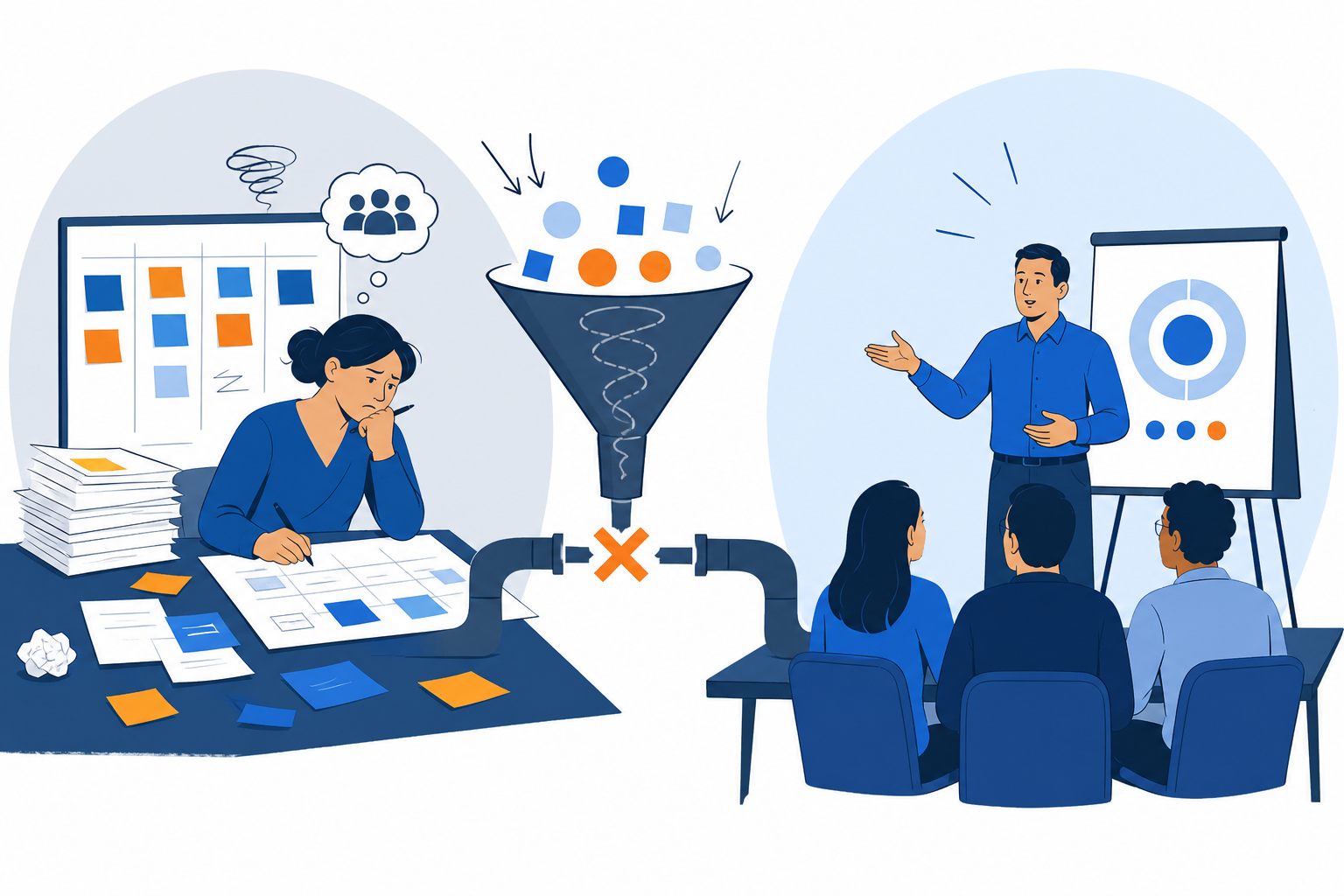
A strong facilitator can teach discovery well. That doesn’t mean discovery is your biggest gap. Reps may uncover pain but fail to connect it to business impact. They may run a solid demo, then lose control because nobody mapped the decision process.
The status quo has some merit. A standard curriculum gives the team common language and can introduce useful concepts quickly. Keep it when the whole team truly lacks the same foundation. Drop it when call evidence shows different problems by role, segment, or stage.
Before approving a topic, ask:
- Which funnel metric points to a problem?
- Which call behavior could explain it?
- How often does that behavior appear?
- Which roles and stages show it?
- What should a manager hear or see afterward?
If you can’t answer those questions, you’re buying content before diagnosing the work.
One Workshop Cannot Carry Manager Behavior
A rep attends training on Tuesday. On Wednesday, their manager reviews pipeline and asks only for close dates. By Friday, the rep has learned the real standard: update the CRM, protect the forecast, and keep moving.
Training loses that fight. Every time.
Managers don’t need to become full-time trainers. They need a shared definition of good, a call-review structure, and one behavior to reinforce. Without that layer, the workshop becomes an isolated event while the weekly management cadence teaches something else.
The workshop isn’t your operating rhythm. The manager is.
The Real Gap Sits Between Evidence and Practice
Effective enablement starts by connecting five sources: the sales process, representative calls, funnel metrics, observed skill gaps, and manager behavior. Any one source can mislead you. Together, they show where the motion breaks and what training should address first.
Calls Reveal What Scorecards Hide
A rep can complete every discovery field and still miss the buyer’s real problem. The CRM shows compliance. The recording shows a different story: shallow questions, vague impact, no driving event, and a next step that requires no buyer action.
Call recordings are game film. The score tells you whether you won. The film shows how the play developed, where judgment broke, and what the rep did under pressure. You need both because neither tells the whole story alone.
Use a simple threshold. If the same behavior appears in at least three calls across two or more reps, investigate it as a team capability gap. If it appears once, coach the individual first. Don’t rebuild the curriculum around one ugly call.
Metrics Tell You Where to Inspect
Metrics narrow the search. They don’t prove why performance changed. A weak demo-to-proposal conversion rate might point to poor demos, weak qualification, bad deal criteria, or a pricing mismatch.
That limitation matters. Metrics can’t establish causation on their own, and pretending they can leads to confident but wrong training plans. Their job is to tell you where to inspect calls, stages, and manager behavior.
Start with three comparisons:
- Compare conversion by stage, role, and segment.
- Check sales-cycle movement across the same groups.
- Review representative calls around the largest gap.
A drop in conversion plus a repeated call behavior creates a credible priority. Either signal alone deserves investigation, not a new workshop.
Disconnected Enablement Wastes More Than Training Budget
Disconnected enablement consumes rep time, manager time, and executive attention without changing the behavior behind missed deals. The visible cost is the program fee. The larger cost is teaching a skill the team doesn’t need while the actual gap keeps hurting conversion and sales-cycle movement.
Skill Gaps Spread Through the Funnel
A 20-rep team in a two-hour workshop spends 40 rep-hours in the session. Add manager preparation and follow-up, and the investment grows. That cost can be reasonable when the training addresses a verified gap. It’s hard to defend when the topic came from a content calendar.
The hidden cost appears later, Weak discovery creates feature-heavy demos, and those demos produce vague follow-ups. Vague follow-ups leave champions without a useful case to share internally. One missed behavior travels through the whole deal.
A feature dump is rarely just a demo problem. It often starts earlier, when the rep never learned what outcome mattered or who cared about it. Train the demo alone, and you treat the visible symptom.
Managers Inherit an Impossible Reinforcement Job
Managers can’t reinforce twelve new behaviors at once. Give them a long competency model, a dense workbook, and no call examples, and they’ll choose whatever is easiest to inspect. Usually CRM activity.
The better constraint is one or two observable behaviors per coaching cycle. A discovery cycle might focus on quantifying impact and confirming a driving event. A demo cycle might focus on linking each product chapter to a stated buyer problem.
For each behavior, define:
- What the rep should say or do
- What evidence should appear in the call
- What the manager should ask afterward
- Where the behavior belongs in the sales process
- When the team will review progress
Without that clarity, every manager creates a personal version of the training. Eventually, the cost lands on people, not just budget.
Your Team Feels the Gap Before Reporting Does
Ready to get started? Start with the Founder-Led Revenue Path on Caliber, including Daniel Hebert’s Foundations of Founder-Led Sales..
Sales teams feel disconnected enablement as mixed messages. Reps hear one standard in training, another in pipeline review, and a third during deal escalation. Managers get held accountable for change without clear evidence, practice, or time to coach it.
Reps Hear a Different Standard From Every Manager
A rep leaves a workshop believing deeper discovery matters. Their next manager asks why the demo wasn’t booked during the first call. Another manager tells a different rep to show the product earlier. Both instructions may be reasonable in context, but the team can’t see the context.
Confusion looks like inconsistency from leadership. Reps stop treating training as the way the company sells and start treating it as temporary advice. Frankly, that response makes sense. People follow the behavior that gets inspected every week.
Enablement Leaders Lose Trust When Activity Replaces Change
Enablement can report attendance, completion, and satisfaction. Those measures prove delivery. They don’t show whether reps changed what they do on calls.
Leaders feel the pressure quickly, you ran the sessions, and Managers said they were useful. Three months later, the same deal risks appear in pipeline review, and nobody can explain what changed.
Trust comes back when the team can see how the plan was built, which behavior matters now, and what evidence will show improvement.
How to Build Training From Sales Evidence
Start with evidence. Diagnose the sales motion, identify observable behaviors, and build training around live work. The goal is to connect what shows up in calls, pipeline, and process to the smallest set of interventions worth reinforcing.
Diagnose Before You Design
What should you inspect first? Begin where business performance and observed behavior appear to meet. A conversion drop tells you where to look. Calls show what reps did. Process and stakeholder input show whether stages and expectations reflect how deals actually progress.
Run the diagnosis in sequence:
- Audit the process: Check stages, exit criteria, buyer actions, and team expectations.
- Review the metrics: Look at conversion, pipeline, cycle, and activity indicators to see where the motion is breaking.
- Sample calls: Review a cross-section of calls across roles and stages.
- Code behavior: Identify recurring behaviors and separate isolated mistakes from system-wide patterns.
- Connect the evidence: Compare call patterns with stages, conversion, cycle, pipeline health, and manager practices.
- Prioritize the response: Use the diagnosis to decide which skills, process changes, or coaching interventions matter most.
Sampling matters. Ten calls from one top performer won’t describe the team. Neither will ten failed deals from one territory. Choose a cross-section before drawing conclusions, or your plan will carry the bias of your sample.
For leaders who need a shared foundation before applying the diagnosis to their own calls, start with the Founder-Led Revenue Path on Caliber, including Daniel Hebert’s Foundations of Founder-Led Sales. Caliber is the external learning platform, and Daniel contributes as an instructor. It teaches discovery, positioning, demos, and an early sales process. It doesn’t replace a team-specific audit.
Turn Evidence Into a Prioritized Capability Plan
Once the evidence is clear, turn it into a written plan. A prioritized sales enablement plan should define the target capabilities, audiences, delivery format, manager reinforcement, and measurement. The point is to sequence the smallest set of interventions with clear owners and evidence of adoption.
That plan can combine group training, manager reinforcement, and individual coaching depending on the diagnosed behavior, role, and operating context. The format should follow the evidence, not habit.
Make Managers the Reinforcement Layer
Training introduces the behavior. Managers make it normal. Without their involvement, reps must translate a broad lesson into a live deal while working against deadlines and old habits.
The reinforcement layer should stay close to actual work. Weekly coaching and call review uses recent calls to build repeatable behavior. Weekly pipeline and deal review turns forecast conversations into decisions and coaching by reviewing risk, evidence, next decisions, and rep actions using a consistent structure. And when a seller needs tighter feedback, two call reviews per month can identify the exact point a discovery, demo, pricing, or follow-up conversation lost or gained momentum.
Group training works for shared language and common patterns. One-to-one coaching works when a specific role or seller needs more direct support. SalesMVP Lab also supports custom group and 1:1 coaching plans, matched to the diagnosed behavior and manager environment.
For teams working through discovery and qualification, the FOUNDER Framework gives Caliber learners and coaching engagements a practical structure for buyer context: Facts, Objectives and Pain, Uncovering Impact, Negative Consequences, Driving Events, and Reaching a Decision. Used well, it supports better judgment in live conversations without replacing listening or coaching.
Either way, the standard must stay visible in calls, deal reviews, and metrics. The remaining choice is whether you build that review layer internally or bring in outside judgment.
How SalesMVP Lab Builds Evidence-Based Enablement
SalesMVP Lab starts with an audit rather than a generic training menu. The work examines the sales process, representative calls, funnel evidence, and manager environment. From there, the engagement produces a prioritized plan for group training, individual coaching, manager reinforcement, and measurement.
Audits Connect Process, Calls, and Metrics
SalesMVP Lab can combine four verified parts of the diagnosis:
- Sales process and stage audit: Review stages, exit criteria, buyer actions, and team expectations.
- Representative sales-call audit: Identify repeated behaviors across roles and deal stages.
- Funnel, conversion, pipeline, and metric audit: Connect performance evidence to likely process or skill gaps.
- Prioritized sales enablement plan: Define target capabilities, audiences, delivery formats, owners, reinforcement, and measurement.
An audit diagnoses and ranks the work. It doesn’t prove that one behavior caused every performance gap, and it doesn’t promise revenue lift. Call quality, data quality, and sample choice still matter.
That restraint makes the plan more useful. You know what the evidence supports, what remains uncertain, and what needs to be tested through coaching.
Coaching Applies the Plan to Live Work
A written plan can clarify priorities. Repeated application turns those priorities into behavior. SalesMVP Lab can use weekly team training and call review, plus custom group and 1:1 coaching plans, to match the format to the diagnosed gap.
The team still owns execution. Managers still need to inspect behavior, coach deals, and track adoption. No external coach can replace that accountability.
When your audit shows repeated gaps in discovery, demos, follow-up, or manager coaching, need help applying the framework to live deals or your team? Work directly with SalesMVP Lab. The first conversation should focus on your process, calls, metrics, and manager cadence. Not a generic workshop.
Build the Capability Plan Your Team Can Use
Start with evidence. Decide which behavior matters. Give managers a way to reinforce it, then check the calls and metrics again.
Your team doesn’t need more sales content. It needs a clear answer to three questions: what should change, why does it matter, and how will managers know it happened?
Learn the framework, Apply it to live deals, and Build a team that can repeat it.

About Daniel Hebert
Daniel Hebert is a sales coach, operator, and teacher with 13 years in SaaS. He helps early-stage founders close more of the pipeline they already have, hire and manage their first reps, and build practical sales frameworks their teams can actually use.
Connect with Daniel Hebert on LinkedIn