

Closing and Deal Progression
How to Diagnose a Closing Problem From Stage Conversion
September 18, 2026 · 12 min read
TL;DR
Diagnosing closing problems requires understanding the buyer's needs and decision-making process, rather than just adding leads. Build a Minimum Viable Sales Process to improve execution, ensure effective discovery, and increase conversion rates.
The buyer asks for pricing, so you send the proposal. But you still don't know who approves the spend. You don't know why they need to act now. And you don't know what happens if they wait.
The opportunity looks real in your CRM. The buyer attended the demo and asked good questions. Yet the deal has no clear decision path. More follow-up won't fix what you never learned.
Founders often treat deals like this as pipeline problems. So they add leads, rewrite emails, or start interviewing their first sales rep. But the real problem is usually closer to the deal. Your sales motion isn't consistent enough to diagnose, repeat, or teach.
Founder-led sales isn't charisma. It's a collection of practical skills. You can learn them, apply them to live deals, and capture what works in a Minimum Viable Sales Process.
More pipeline won't repair weak execution
More pipeline gives you more opportunities to repeat the same mistakes. Weak discovery produces weak demos. Weak demos lead to vague follow-up. Vague follow-up leaves the buyer to figure out the decision alone.
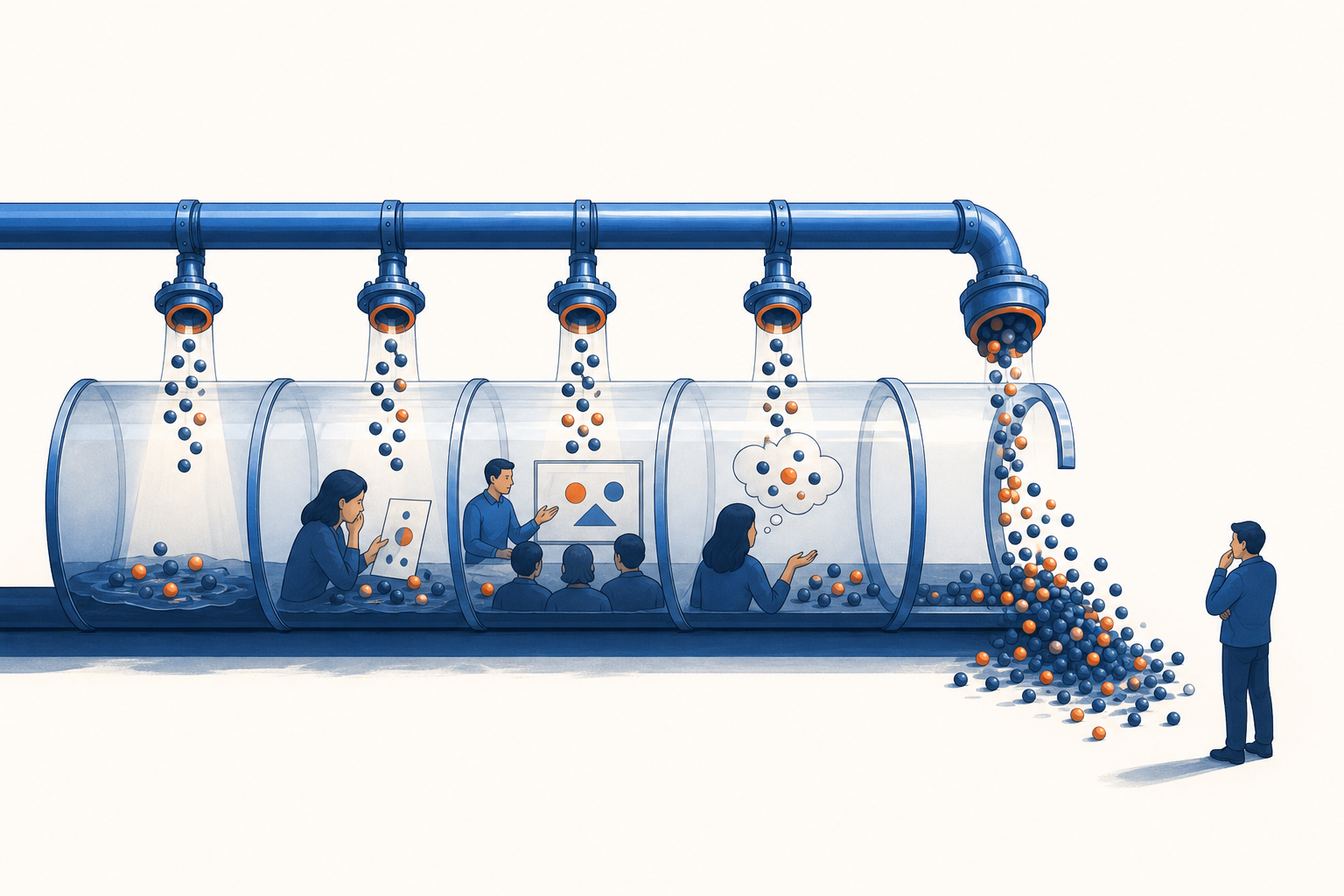
That's an expensive place to lose a deal. You already earned the meeting. You invested time in discovery, preparation, demos, and follow-up. The buyer invested time too.
Adding leads can hide the problem for a while. Your pipeline gets bigger, but your win rate stays inconsistent. Sales cycles stretch because opportunities remain open without a real driving event. Eventually, nobody knows which deals deserve attention.
Start by separating pipeline creation from pipeline conversion. Demand generation creates buyer conversations. Your sales process determines what happens inside them. Both matter, but they solve different problems.
Look at your recent qualified opportunities. Don't ask whether you sent enough emails. Ask whether you learned enough to guide the buying decision.
- What problem is the buyer trying to solve?
- Why does that problem matter to the business?
- What happens if they leave it alone?
- Is there an event driving action?
- Who will participate in the decision?
- What specific buyer action happens next?
Missing answers point to missing work. They also tell you where to return in the next conversation. Discovery is a process, not an event.
Find where your deals lose momentum
Your CRM stage won't tell you why a deal stalled. It only tells you where someone placed the opportunity. You need evidence from calls, emails, buyer actions, and the deal history.
Start with a small set of qualified deals. Include wins, losses, and opportunities that stopped moving. Then compare what you actually learned in each one.
Review evidence, not optimism
Founders know their products deeply. That makes it easy to fill gaps with assumptions. A buyer saying, "That would be useful," becomes strong pain. A request for pricing becomes buying intent.
Neither statement proves the buyer will act. Strong pain connects to an objective the buyer already cares about. Buying intent shows up through actions, such as involving another stakeholder or completing an agreed evaluation step.
Review each opportunity using six areas from the FOUNDER Framework:
- Facts: What do you know about the company, current process, team, and environment?
- Objectives and Pain: What are they trying to achieve, and what is blocking them?
- Uncovering Impact: How does the problem affect the business or the buyer?
- Negative Consequences: What changes if they do nothing?
- Driving Events: Why would they address the problem now?
- Reaching a Decision: Who is involved, what matters, and how will they decide?
Don't use the framework as a script. Buyers don't experience their problems in acronym order. Use it as a way to notice missing context across the buying journey.
Listen to the calls
Your memory keeps the general shape of a conversation. It often misses the exact moment where momentum changed. Call review gives you something more useful: observable behavior.
Listen for where you accepted a vague answer. Notice when you switched into a product pitch before understanding the impact. Check whether the buyer described the next step, or whether you assigned one without agreement.
Then choose one behavior to improve. Don't create a giant list of everything you disliked. Maybe you need to ask one more impact question. Maybe you need to pause after an objection instead of defending the product.
Small call-level changes compound because you can use them again. They also make coaching practical. You're no longer discussing sales in general. You're deciding what to do differently on the next live call.
If you want a second set of ears on those calls, you can work directly with SalesMVP Lab on live deals or your team. Bring the call evidence and deal context. You'll still own the execution.
Build your Minimum Viable Sales Process
Your sales process probably exists already. It lives inside your calendar habits, demo choices, follow-up emails, and judgment. The problem is that nobody can see the whole thing, including you.
A Minimum Viable Sales Process captures the smallest teachable version. It isn't enterprise bureaucracy. It's a process you can test, measure, and improve as you learn from more deals.
A useful starting flow for a consultative SaaS sale might include:
- Intro and discovery: Understand the buyer's environment, problem, impact, and fit.
- Demo: Show the relevant workflows in the context of discovered pain.
- Implementation and proposal review: Confirm requirements, stakeholders, scope, and decision criteria.
- Pricing and negotiation: Resolve commercial questions and align on the remaining decision steps.
Your motion may need a trial, technical review, or extra stakeholder call. That's fine. The goal isn't to force every buyer through four calls. The goal is to understand why each call exists and what buyer evidence allows the deal to advance.
Give each call a job
A meeting without a clear job becomes a conversation you hope goes well. Define the objective before the call. Then decide what you need to learn, what the buyer needs to understand, and what decision should happen next.
Discovery should establish more than basic qualification. Learn what triggered the conversation. Understand what the buyer is trying to change and why the current approach isn't good enough.
You also need impact. A frustrating workflow may get attention, but attention doesn't create a budget. Connect the problem to an operational consequence, business result, or priority the buyer already owns.
Daniel's Foundations of Founder-Led Sales covers these mechanics through discovery, positioning, demos, and a repeatable early sales process. To build that foundation through self-directed learning, start with the Founder-Led Revenue Path on Caliber, including Daniel Hebert's Foundations of Founder-Led Sales. Caliber is the external learning platform, and Daniel contributes the course as an instructor.
Build demos around pain
A demo isn't a product tour. It should show how your product addresses the problem the buyer described. Otherwise, you're asking them to translate features into value on their own.
Organize the demo into chapters. Each chapter should focus on a specific problem and the workflow that addresses it. Use a simple structure:
- Problem: Restate the pain you learned.
- Solution: Explain your approach.
- Show: Demonstrate the relevant capability.
- Ask: Invite the buyer to connect it to their environment.
The question matters. It turns screen sharing back into a buyer conversation. You learn whether the workflow fits, what concerns remain, and who else might care.
The reason this structure works is simple: discovery, demo, and follow-up should reinforce the same buyer problem. When a founder reworks discovery to map real pain, then anchors each demo chapter to that pain, the buyer stops translating features on their own. That alignment is the point, not any single template.
Make follow-up part of discovery
A recap email shouldn't say, "Thanks for your time. Let me know if you have questions." That gives the buyer no useful summary and leaves the next step open.
Write the recap so it can travel inside the account. Restate the buyer's situation, objective, impact, and relevant capabilities. Then document the driving event, decision factors, and agreed actions.
A practical recap can use four sections:
- Facts, objectives, and pain
- Impact and consequences
- Relevant capabilities
- Driving events and decision process
Finish with one buyer action and one seller action. Add the agreed timing for both. If the buyer won't commit to an action, you've learned something important about the opportunity.
Map the decision before the proposal
A proposal isn't a decision process. It's one artifact inside one. Sending it early can make the deal feel active while avoiding the harder questions.
Ask who else needs to participate. Learn what criteria they'll use, whether security or legal will review the purchase, and who approves the budget. Find out how they bought similar software before.
You don't need every answer during the first discovery call. You do need to keep learning. New stakeholders can introduce new pain, risks, and criteria that change the deal.
Your job isn't to pressure the buyer. Your job is to make a complex decision easier. That requires understanding how the decision actually gets made.
Improve the process with live evidence
A documented process gives you a starting point. Live deals show you whether it works. The loop is simple: run the process, review the evidence, change one part, and test it again.
When a team standardizes qualification, follow-up, and call sequencing inside a Minimum Viable Sales Process, the payoff isn't magic. It's a repeatable way to qualify opportunities and follow through, so weak deals get flagged earlier and strong deals move on evidence instead of hope.
Process alone doesn't guarantee a result. Product fit, pipeline, market conditions, and execution still matter. What the process gives you is a consistent way to see where deals break and a shared language to fix it.
Use metrics to find the question
Metrics tell you where to investigate. They don't automatically tell you what caused the result. A lower demo-to-close rate could come from weak qualification, weak demos, missing urgency, or a change in the deals entering your pipeline.
Review conversion, pipeline, sales cycle, and activity together. Then compare those numbers with representative calls and opportunities. The combination gives you a better diagnosis than either source alone.
For example, a longer sales cycle is only a signal. Call evidence may show that buyers aren't involving financial approvers until late. Or your process may be advancing deals without an agreed next action.
Use the metric to choose where to look. Use deal and call evidence to decide what to change. Then watch whether the behavior and result move together over time.
Add experienced judgment where it matters
Founders rarely have a sales manager reviewing their calls. They make the call, write the follow-up, update the CRM, and decide what to do next. Any weak assumption can survive because nobody challenges it.
SalesMVP coaching uses current calls, deals, and process questions as the working material. Two coaching sessions and two call reviews per month can focus on the most important situations. Weekly coaching and call review provides a tighter cadence when the process needs more active development.
The founder remains accountable for execution. Coaching isn't outsourced closing. Its role is to bring experienced sales leadership judgment into the decisions you're already making.
Give your first sales rep something teachable
Hiring a first sales rep doesn't remove an undefined process. It hands the undefined process to someone with less product context and less founder intuition. They now have to learn the market while guessing how you qualify, demo, follow up, and close.
Start by tightening the parts of the motion that need to be teachable. A sales process and stage audit can test whether your stages, exit criteria, buyer actions, and team expectations reflect how deals actually progress. From there, light enablement support can help you improve scripts, demo structure, follow-up, positioning, and practical process assets. Keep it small enough to use.
Then create a management rhythm. A weekly pipeline and deal review should examine risk, evidence, next decisions, and rep actions. It shouldn't become a tour of every CRM field.
Call review belongs in that rhythm too. Review a representative cross-section of calls to spot repeated behaviors before declaring a team-wide problem. Then reinforce one or two changes through weekly team training and call review.
A small team may also need hands-on sales management before it needs a full-time sales leader. That can establish expectations, review performance, coach deals, and improve the operating cadence. Company leadership still retains executive and employment accountability.
SalesMVP Lab isn't for founders looking for outsourced lead generation or someone else to own every sales call. It also won't create product-market fit when you lack meaningful buyer conversations. The work fits founders and teams with active opportunities who want to improve how those opportunities are handled.
When you need support on current calls, opportunities, and team development, you can work directly with SalesMVP Lab on your deals or team. Bring the call evidence and deal context. You'll still own the execution.
Close the deals you already earned
You don't need to rebuild your entire sales motion at once. Start with a few qualified opportunities. Review the evidence, find what's missing, and improve one behavior.
Then document what works. Turn founder intuition into a Minimum Viable Sales Process your first sales rep can inherit. Use calls, deals, and metrics to keep improving it.
Learn the framework. Apply it to live deals. Build a team that can repeat it.

About Daniel Hebert
Daniel Hebert is a sales coach, operator, and teacher with 13 years in SaaS. He helps early-stage founders close more of the pipeline they already have, hire and manage their first reps, and build practical sales frameworks their teams can actually use.
Connect with Daniel Hebert on LinkedInFrequently asked questions
How do I identify why a deal stalled?
To find out why a deal has stalled, start by reviewing the evidence from your interactions. Look at calls, emails, and any actions taken by the buyer. Use the FOUNDER Framework to analyze the situation: 1) Identify the facts about the company and its environment. 2) Clarify the objectives and pain points of the buyer. 3) Assess the impact of the problem and the consequences of inaction. This structured approach helps you pinpoint where the conversation may have lost momentum and what you need to address next.
What if I don't know who makes the decision?
If you're unclear about who makes the buying decision, it's crucial to ask directly during your conversations. Use targeted questions such as, 'Who else needs to be involved in this decision?' or 'What criteria will you use to evaluate options?' This helps you map out the decision-making process and ensures you engage all necessary stakeholders. Document this information to guide future discussions and follow-ups effectively.
How do I structure my follow-up emails?
To create effective follow-up emails, use a structured approach that reinforces key insights. Start with a clear subject line that summarizes the call. In the body, recap the facts and objectives discussed, highlight the impact and consequences of the buyer's situation, and outline the relevant capabilities your solution offers. Finally, specify the next steps for both you and the buyer, including any agreed-upon actions and timelines. This clarity keeps the momentum going and aligns everyone involved.
When should I ask about the buyer's urgency?
You should inquire about the buyer's urgency early in the conversation, especially during the discovery phase. Ask questions like, 'What prompted you to explore this solution now?' or 'Are there any critical events driving this decision?' Understanding the urgency helps you gauge the buyer's motivation and can influence how you position your solution. If urgency is lacking, you can work to create a sense of urgency by discussing the negative consequences of inaction.