
Closing and Deal Progression
How to Turn “Send Me Something†Into a Real Sales Next Step
September 19, 2026 · 11 min read
TL;DR
Transform your sales process by connecting product differences to buyer needs. Focus on their current alternatives, why they matter, and the business impact of your solution. This approach leads to clearer differentiation and more effective sales conversations.
You finish the demo. The buyer asks how you're different. You list features, workflows, and technical details. They leave with more information, but no clear reason to choose you.
That's the problem with most SaaS positioning. The features may be different. The buyer just doesn't understand why those differences matter to their business.
Features don't create differentiation by themselves. A feature becomes useful when it connects to a meaningful outcome and a buyer who cares. Until you make that connection, you've given the buyer another item for their comparison sheet.
Your sales process needs to carry that connection through discovery, demos, follow-up, and the final decision. Not just your website. Not just one slide.
Your product knowledge can work against you
You understand your product better than anyone. You know why certain architecture choices matter. You remember the customer request behind each workflow. You can explain every setting.
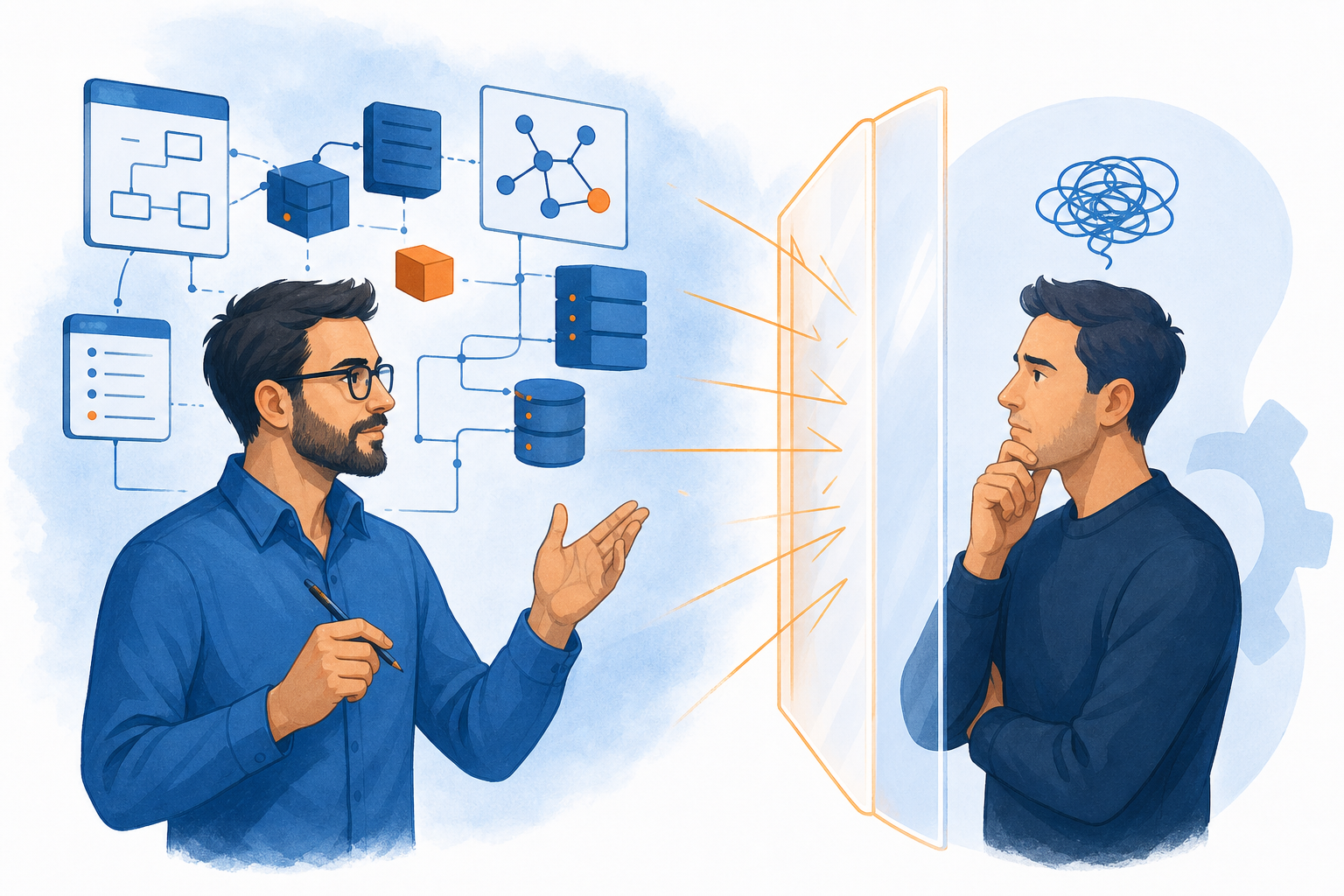
So when a buyer asks what makes you different, you start teaching the product. You assume the value will become obvious once they see enough. It usually doesn't.
The buyer has a different job. They're comparing your product against competitors, internal workarounds, and doing nothing. They need to understand which problem your difference solves, what changes if they buy, and whether that change matters enough to act.
More product detail can make that decision harder. The buyer now has more information to organize, more claims to verify, and more questions to bring back to their team. You answered the feature question without answering the buying question.
A useful sales process keeps you focused on four things:
- What the buyer uses today
- Where that alternative fails
- Why your approach is meaningfully different
- Who receives the business impact
If you can't explain those four things, you don't have usable differentiation yet. You have a product description.
The gap usually appears in calls. Discovery changes based on what you remember to ask. Demos follow whichever features the buyer mentioned. Follow-up summarizes the conversation without reinforcing the decision.
The process lives in your head. Your intuition may still carry some deals, but it's hard to inspect. It's even harder to give to your first sales rep.
A Minimum Viable Sales Process captures that intuition. It's the smallest teachable process you can run, test, and improve. No enterprise bureaucracy required.
If you want help turning that intuition into something you can run against a live deal, work directly with SalesMVP Lab.
Build a positioning chain
Start with the buyer's current alternative, not your product. The alternative might be another vendor. It might be a spreadsheet, an internal process, or a problem the buyer has accepted.
You need to understand why they use it. Cost may matter. Familiarity may matter more. Switching could require approval, implementation work, or political support from another department.
Once you understand the alternative, you can build a simple positioning chain:
- Alternative: What are they doing now?
- Difference: What can your product do differently?
- Impact: Why does that difference matter?
- Buyer: Who cares about that impact?
Every link matters. Remove one, and the claim gets weaker.
Name the real alternative
Founders often compare themselves against their closest software competitor. Buyers don't always think that way. They may be choosing between your product and keeping the current process for another quarter.
Ask how the buyer handles the problem now. Find out what works, what breaks, and why they started looking. Then ask what happens if they leave the process unchanged.
Those answers give you the real comparison. They also tell you whether a buying process exists. Interest without a reason to change can create a long sales cycle that ends in no decision.
Identify the useful difference
A difference is not automatically valuable. Your architecture may be unique. Your workflow may be faster. Your data model may support something competitors can't.
The next question is what that difference allows the buyer to do. If you can't answer that, keep working.
A B2B SaaS customer-feedback company offered a useful example. Its product could connect customer feedback with CRM revenue data. The feature was different, but the stronger message was that product teams could prioritize requests using revenue context instead of relying only on gut.
Now the buyer can understand the chain. The current alternative separates feedback from commercial context. The product connects them. A product leader can use that context when deciding what to build.
Find the person who cares
The same capability can matter for different reasons. A product leader may care about prioritization. A revenue leader may care about requests from important accounts. An executive may care about how product investment connects to retention or growth.
Generic positioning tries to speak to all of them at once. Strong discovery finds the person, objective, and problem in the current deal. Your message can then reflect what that buyer is trying to change.
Ask practical questions:
- Who experiences the problem most often?
- Who owns the metric affected by it?
- Who needs to support the purchase?
- Who could block the decision?
- What does each person need to believe?
Your differentiation becomes stronger as it gets more specific. Not because you added detail, but because you connected the right detail to the right person.
Carry differentiation through every conversation
Discovery is a process, not an event. You won't learn everything during the first call. New stakeholders bring new objectives, concerns, and decision criteria.
Use the FOUNDER Framework across the buying journey. It gives you six areas to keep developing:
- Facts: The buyer's environment and current process
- Objectives and Pain: What they want and what prevents it
- Uncovering Impact: How the problem affects the business
- Negative Consequences: What happens if nothing changes
- Driving Events: Why they may act now
- Reaching a Decision: How the buying process works
Don't turn the framework into an interrogation checklist. Listen to the buyer, follow useful threads, and note what remains unknown. The framework supports judgment. It doesn't replace it.
A positioning claim may begin during discovery, become clearer during the demo, and change when another stakeholder joins. That's normal. Your job is to keep connecting product differences to buyer context.
For a structured introduction to that approach, start with the Founder-Led Revenue Path on Caliber, including Daniel Hebert's Foundations of Founder-Led Sales. Caliber delivers the self-directed learning, while Daniel contributes the founder-led sales course covering discovery, positioning, demos, and a repeatable early process.
Use discovery to earn the demo
Your demo should reflect what you learned. If discovery uncovered three problems, build the demo around those problems. Don't open your product and decide what to show as you go.
Think in chapters. Each chapter should follow a simple flow:
- Name the buyer's problem.
- Explain your approach.
- Show the relevant workflow.
- Ask how it would fit their business.
The question matters. You want the buyer to imagine using the product, not just watch you use it. Their answer also gives you more discovery.
You may learn that the workflow affects another team. You may uncover an implementation concern. You may find that the feature you expected to matter isn't important to this buyer.
Good. Adjust the deal around evidence.
The customer-feedback company used this approach during coaching. Discovery focused more consistently on pain and business impact. Demos moved away from broad feature tours and connected the product to the buyer's desired outcome. The useful lesson isn't a specific number. It's how the sales motion changed. Positioning became part of discovery, demo structure, and follow-up instead of a claim delivered once.
Reinforce the decision in follow-up
Your follow-up should do more than thank the buyer and attach a proposal. It should document what you learned and make the next decision easier.
A useful recap covers:
- The buyer's current situation and objective
- The pain or friction discussed
- The business impact and consequences
- The relevant capabilities
- The driving event
- The decision process
- The buyer's action and your action
Write it so the buyer can forward it internally. A stakeholder who missed the call should understand why the company is considering change, why your approach fits, and what needs to happen next.
Weak follow-up loses the positioning you built during the call. The buyer has to reconstruct your argument for everyone else. Most won't do it as well as you can.
Map the decision before sending pricing
Pricing is only one part of the decision. You also need to understand evaluation criteria, approval steps, people involved, and any required review.
Ask early. Keep updating the answers as the deal develops. A new stakeholder can change the process.
If the buyer needs security approval, plan for it. If finance controls the budget, understand when they enter. If another executive needs to see the demo, don't assume your champion can sell the product alone.
Differentiation doesn't matter if the right people never hear it. Your sales process should carry the narrative into each decision.
Turn founder judgment into a repeatable process
You probably adapt your sales calls without thinking about it. You notice when the buyer becomes interested. You know which customer story fits. You can tell when a technical question is really a risk question.
Your first sales rep won't inherit that judgment through a folder of scripts. You need to make the important choices visible. Document the process while you're still close to the calls.
Start with:
- The typical call sequence
- The objective for each call
- The information needed before advancing
- The problems your demo chapters address
- The evidence required for qualification
- The standard follow-up structure
- The buying decisions that must be mapped
- The metrics you review
Keep it small. Run it against live opportunities. Change it when call evidence or metrics show a gap.
A developer-tools company followed a similar path after inconsistent qualification and follow-up. The company implemented a Minimum Viable Sales Process that simplified its call sequence and sales narrative. The point isn't a headline growth number. Founder judgment became something the company could repeat and improve, and a first sales rep could actually follow.
Add the right support layer
Self-directed learning works when you need structure and can apply it yourself. The Founder-Led Revenue Path on Caliber provides that learning layer. It doesn't include personalized call review or hands-on deal management.
Live deals often expose a different need. You may understand the framework but struggle to hear where a call lost momentum. You may need experienced judgment on a pricing conversation, a stalled deal, or a first sales rep who isn't following the process.
SalesMVP Lab works on those situations through coaching and hands-on sales leadership. Two coaching sessions and two call reviews per month can focus on current calls, deals, and the next behavior to change. Weekly coaching and call review provides a tighter cadence when you need more regular application.
For an early team, weekly pipeline and deal review turns the meeting from a status update into decisions and coaching. A sales process and stage audit can assess whether stages, exit criteria, and buyer actions reflect how deals actually progress. A monthly sales-metric audit can then direct attention toward conversion, pipeline, cycle, and activity gaps, assuming the underlying data is usable.
None of those options replace founder accountability. They don't provide outsourced closing or guarantee revenue. The point is to add the judgment of someone who has operated and managed sales teams while you build a process your team can inherit.
If call review keeps exposing the same positioning or decision gaps, work directly with SalesMVP Lab. Bring the actual calls, opportunities, process questions, and metrics so the work stays connected to what buyers are doing.
Test your positioning on one live deal
Pick one qualified opportunity from your pipeline. Don't rewrite the website yet. Start with the deal in front of you.
Answer these questions:
- What alternative is the buyer using?
- Why is that alternative no longer enough?
- Which product difference matters here?
- What business impact does it create?
- Who cares about that impact?
- What happens if they do nothing?
- Why would they act now?
- How will they reach a decision?
- What remains unknown?
Use the missing answers to plan your next call. Change the demo around the buyer's pain. Write the follow-up around the business decision, not your feature list.
Then document what worked. Apply it to the next deal. Give your first sales rep something better than founder intuition and a CRM full of notes.
Your features may be different. Your sales process makes that difference matter.

About Daniel Hebert
Daniel Hebert is a sales coach, operator, and teacher with 13 years in SaaS. He helps early-stage founders close more of the pipeline they already have, hire and manage their first reps, and build practical sales frameworks their teams can actually use.
Connect with Daniel Hebert on LinkedInFrequently asked questions
How do I build a strong follow-up after a sales call?
To create an effective follow-up, start by summarizing the key points discussed during the call. Include the buyer's current situation, their objectives, and the pain points you identified. Next, outline the business impact of those pain points and how your product can address them. Finally, clarify the next steps for both you and the buyer, ensuring it's easy for them to share your recap with their team. This structured approach reinforces your positioning and keeps the conversation moving forward.
What if my demo doesn't connect with the buyer's needs?
If your demo isn't resonating, revisit your discovery notes to ensure you're addressing the specific problems the buyer faces. Tailor your demo to highlight features that directly solve these issues. Use a chapter format: start by naming the buyer's problem, explain how your product provides a solution, show the relevant features, and then ask how it fits their business. This method helps the buyer visualize using your product in their context, making the demo more impactful.
How do I identify the right decision-makers during the sales process?
To find the right decision-makers, ask open-ended questions during your discovery calls. Inquire about who else is involved in the decision-making process and what criteria they will use to evaluate options. Pay attention to who experiences the problem most often, as they are likely to have a vested interest in the solution. Mapping out the decision-making structure early can help you tailor your approach and ensure that the right people are engaged throughout the sales journey.
When should I adjust my sales process?
You should consider adjusting your sales process whenever you notice consistent gaps in qualification, follow-up, or conversion rates. Regularly review your metrics and feedback from calls to identify patterns. If certain stages are taking longer than expected or if you're losing deals at specific points, it may be time to refine your Minimum Viable Sales Process. Testing new approaches in live opportunities can help you learn and improve your process over time.