
Corporate Sales Training and Enablement
What a Representative Sales Call Audit Should Measure
September 2, 2026 · 12 min read
TL;DR
To improve sales execution, focus on diagnosing sales motions using call data and funnel metrics before training. Define observable behaviors and reinforce them with a structured coaching cadence to ensure real change, rather than relying on generic training.
You ran a training session this week. By Friday, three managers were coaching the same behavior three different ways. Reps heard the lesson, passed the quiz, and returned to their old calls. The calendar says training happened. The calls say otherwise.
More training won't fix that gap. You need to know what's breaking, where it breaks, and which behavior should change first. Then managers need a clear way to reinforce it. Without that evidence, enablement becomes a schedule of activities rather than a plan for better sales execution.
Learn more about Need help applying the framework to live deals or your team? Work directly with SalesMVP Lab..
Key Takeaways:
- Diagnose the sales motion before choosing training.
- Use calls and funnel metrics together.
- Define behaviors managers can actually observe.
- Teach one or two changes at a time.
- Give managers a repeatable coaching cadence.
- Measure adoption before claiming performance improved.
Why Generic Sales Training Fails to Change Calls
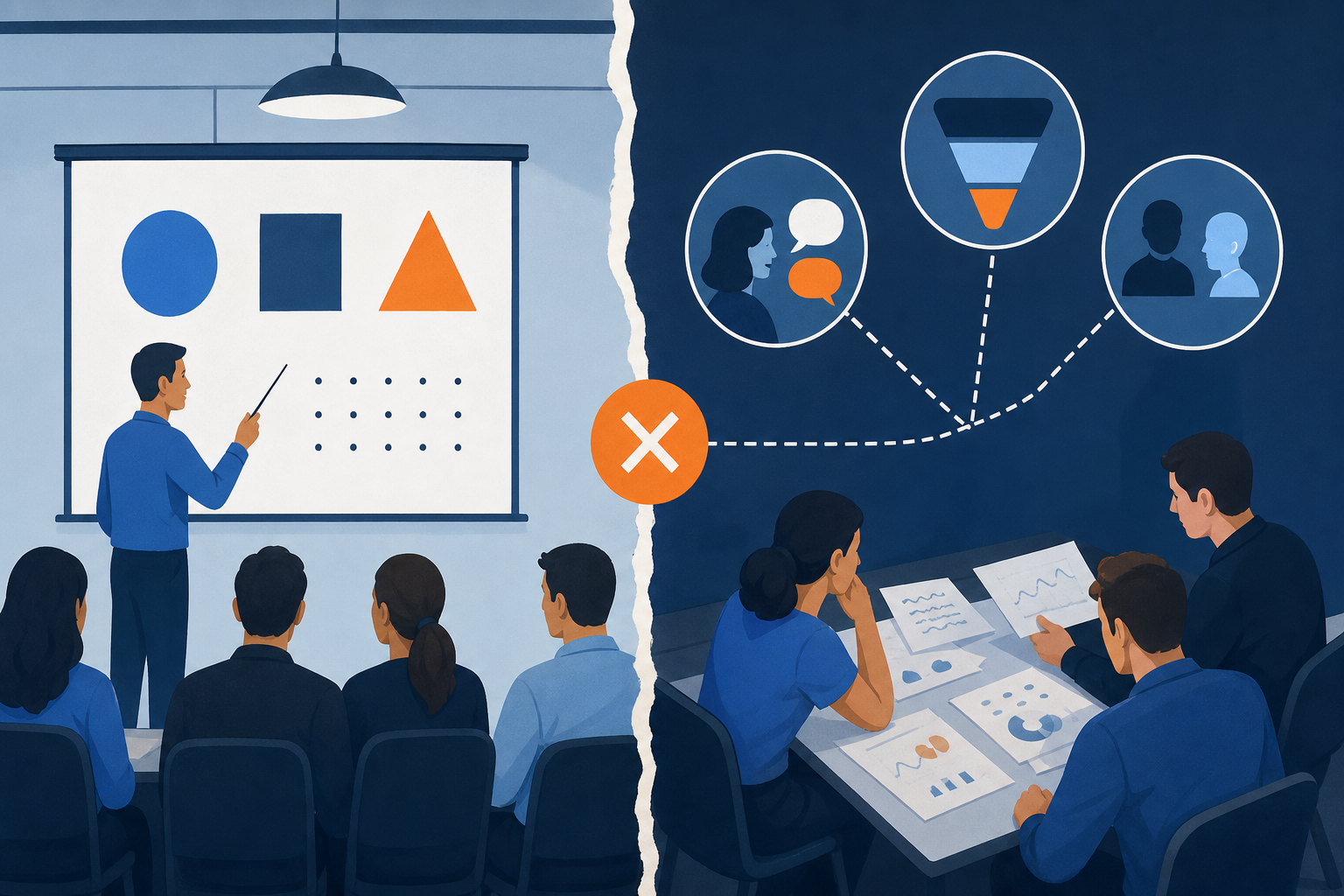
Generic sales training fails because it starts with content instead of evidence. What it teaches is whatever seems broadly useful, not what your calls, funnel, and managers show the team actually needs. Reps may learn new language, but their behavior rarely changes without practice and reinforcement.
The Curriculum Starts Before the Diagnosis
At 8:40 on Tuesday morning, an enablement leader opens six call recordings in Gong. Three reps move from pain to demo without discussing business impact. Another rep never confirms who will approve the purchase. Yet the workshop scheduled for Thursday covers objection handling, because several managers requested it.
The workshop may still be useful. It just isn't aimed at the problem shown in the calls. The team learns responses to objections while deals continue to stall earlier, during discovery and decision mapping. That disconnect burns two weeks of prep time and makes enablement harder to defend when the pipeline review lands flat.
Training without diagnosis is like patching production code without reading the logs. You might change something useful. You might also spend two weeks fixing the wrong issue while the real error keeps throwing. The logs, in this case, are your calls, stages, conversion data, and manager observations.
Activity Gets Mistaken for Capability
Attendance proves someone joined. Completion proves someone finished. Neither proves the rep can uncover impact, connect a demo to buyer pain, or secure a useful next step during a live opportunity.
Use a simple decision rule. If you can't name the exact call behavior a program should change, don't approve it yet. If you can name the behavior but can't identify where managers will observe it, the program still isn't ready. Two gates, and most requests fail at least one of them.
I get why enablement teams track completion. It's available, easy to report, and expected by leadership. Keep it for administration. Just don't confuse a green checkmark with proof that selling changed.
Managers Inherit an Unclear Standard
Given no shared standard, managers fill the gap the program leaves behind. One coaches reps to ask more questions. Another wants tighter demos. A third focuses on CRM hygiene because that's what the dashboard shows. Everyone is busy, but the team isn't learning one shared motion.
That inconsistency wears people down. Reps can't tell which feedback matters. Managers feel responsible for reinforcement without being given a clear standard, and enablement gets blamed when the numbers don't move.
A shared slide deck won't solve that. Managers need observable behaviors, examples from current calls, and a cadence for reviewing change. What would the plan look like if the evidence came first?
How to Build Enablement From Sales Evidence
An evidence-led enablement plan starts with the sales motion, then traces performance gaps back to specific behavior. Calls show what reps do. Funnel metrics show where deals slow or exit. Managers reveal whether the behavior is being coached after training.
Audit Where the Sales Motion Breaks
Start by locating the break, not choosing a topic. Review stage conversion, sales cycle movement, representative calls, and the actions buyers take between meetings. You're looking for patterns that appear across more than one rep, not an isolated deal.
A single bad call proves very little. A representative sales-call audit gives you a more reliable starting point by reviewing a cross-section of calls across roles and stages, then coding recurring behaviors to separate isolated mistakes from broader patterns. If the same missed behavior appears across several calls and matches a funnel problem, you have a credible training priority.
Ask these questions in order:
- Where do opportunities lose momentum? Look for conversion drops, stalled stages, and repeated no-decisions.
- What happens on calls before that point? Review the questions, explanations, buyer participation, and agreed next steps.
- Is the issue individual or shared? Compare newer reps, experienced reps, managers, and segments.
- What are managers already coaching? Find gaps between the expected motion and actual reinforcement.
- What evidence would show adoption? Choose a call behavior before choosing a lagging business metric.
Metrics have limits. Poor CRM data can create a false diagnosis, and a small or unrepresentative call sample can overstate one rep's habit. That's a fair concern. Use calls, metrics, process, and manager evidence together so no single source carries the whole decision.
Connect Call Behavior to Funnel Evidence
A funnel problem isn't automatically a training problem. A low demo-to-proposal rate could come from weak discovery, poor fit, confusing pricing, missing product capability, or a stage definition that doesn't match how buyers purchase. Training only belongs in the plan when behavior contributes to the gap.
Trace the chain backwards. Start with the metric, inspect the opportunities, review the calls, and identify what the rep could have done differently. Then check whether the process and manager expectations support that behavior. That final check matters because you can't coach a rep into following a process nobody has defined.
Use a short evidence chain:
- Performance signal: Opportunities stall after the demo.
- Opportunity evidence: Buyers don't add the financial approver.
- Call behavior: Reps ask who is involved but don't map approval.
- Process gap: The stage has no buyer-action exit criterion.
- Enablement response: Teach decision mapping and update manager review.
No single workshop fixes every item in that chain. Sales leadership may need a sales process and stage audit to repair stage criteria while enablement builds practice around the call behavior. Split ownership clearly. Otherwise, reps receive training for a process problem they can't control.
Define the Behavior You Want to Hear
Words like "improve discovery" are too vague to coach. Define what a manager should hear on the call and what evidence should appear afterward. Specificity turns a topic into a capability.
Take "ask better impact questions." Before: a workshop slide and a hope. After: the rep identifies one business effect, tests its size, and confirms who else is affected. "Improve next steps" becomes: the rep confirms the buyer action, seller action, owner, and date before ending the meeting. Now the manager knows exactly what to review on the recording.
Discovery also needs to continue across the buying journey. Facts may come from the first call. Impact may become clearer during the demo. Decision criteria can change when security or finance enters. Discovery is a process, not an event. Frameworks like FOUNDER can help teams work through facts, objectives, impact, consequences, driving events, and decision-making throughout the buying journey rather than as a one-time checklist.
Before approving any behavior, test three things:
- Can a manager hear or see it?
- Can a rep practice it more than once?
- Does it connect to a known deal risk?
If one answer is no, tighten the definition. Frankly, this is where many capability plans get soft. They name a skill, assign content, and skip the observable standard that makes coaching possible.
Build Manager Reinforcement Into the Plan
Managers shouldn't receive finished training and a request to "reinforce it." They need to shape the behavior, see the call examples, and understand what good looks like before the first session. Their role starts during diagnosis.
Give managers one or two behaviors to coach at a time. More creates scattered feedback and makes adoption hard to judge. Hold the focus for at least two weeks unless call evidence shows the behavior was misdiagnosed or the business priority changed.
A practical coaching loop looks like this:
- Set the behavior: Name what the rep should do and why it matters.
- Show evidence: Use a real call segment that demonstrates the gap.
- Practice the moment: Rehearse the question, transition, or explanation.
- Apply it live: Ask reps to use it in current opportunities.
- Review adoption: Inspect later calls and coach the next adjustment.
Group training works when several reps share the same gap. It also creates a common language across the team. Individual coaching is better when the issue depends on role, confidence, deal complexity, or a pattern specific to one seller.
That tradeoff is real. Custom coaching takes more manager time and can be harder to schedule. Use it where the behavior or context differs enough that group practice would become generic again.
Sequence the Smallest Useful Intervention
A strong enablement plan doesn't try to repair discovery, demos, negotiation, qualification, and management in one quarter. It chooses the smallest set of changes that can be taught, applied, and reviewed. Depth beats coverage when the goal is behavior.
Rank each possible intervention by three factors: business impact, strength of evidence, and manager ability to reinforce it. A high-impact gap with weak evidence needs more diagnosis. A clear gap with no manager capacity needs a different delivery plan. Start where all three score strong, and treat that intersection as the smallest teachable process you can test and improve.
Your plan should make ownership visible:
- Enablement owns: content, practice, examples, and adoption checks.
- Managers own: call review, deal coaching, and repeated feedback.
- Sales leadership owns: process, expectations, and performance decisions.
- Reps own: application, preparation, and reflection.
For leaders who want structured, self-directed learning, start with the Founder-Led Revenue Path on Caliber, including Daniel Hebert's Foundations of Founder-Led Sales. Caliber is the external learning platform, and Daniel contributes as an instructor. Self-directed learning can create a foundation, but it doesn't replace call review, manager coaching, or a custom capability plan.
Once the priorities and ownership are clear, you still need a practical way to turn the diagnosis into recurring team behavior.
How SalesMVP Lab Builds Evidence-Led Enablement
Ready to get started? Start with the Founder-Led Revenue Path on Caliber, including Daniel Hebert’s Foundations of Founder-Led Sales..
SalesMVP Lab starts corporate enablement with an audit of the process, calls, metrics, and manager environment. The work then turns those findings into a prioritized plan with clear coaching formats and measures. Training follows the evidence instead of leading it.
Audits Separate Isolated Mistakes From Shared Gaps
SalesMVP Lab can review the sales process and stage definitions to assess whether exit criteria, buyer actions, and team expectations match how opportunities actually progress. A representative sales-call audit then looks across roles and stages for recurring behaviors. Sampling quality matters. Weak or unrepresentative calls limit what the audit can support.
A funnel, conversion, pipeline, and metric audit adds another view. It compares stage movement, cycle, pipeline health, and manager practices with observed call patterns. The audit diagnoses and prioritizes. It doesn't prove causation, guarantee revenue improvement, or replace the leadership decisions that follow.
The analysis can focus on questions such as:
- Are reps moving to demos before impact is clear?
- Do stages reflect seller activity or buyer progress?
- Are stalled deals missing a driving event?
- Do managers coach the same behavior?
- Does the current curriculum address what calls show?
SalesMVP Lab has operated and managed sales teams, so the recommendation isn't limited to curriculum design. It considers what managers can sustain, what leaders need to inspect, and how the behavior appears inside active deals. That judgment is useful when several possible interventions all look reasonable on paper.
Coaching Plans Match the Diagnosed Behavior
The prioritized sales enablement plan defines target capabilities, audiences, delivery format, manager reinforcement, and measurement. Custom group and 1:1 coaching plans can then match the diagnosed behavior to the right role and setting. Scope and success measures are agreed for each engagement rather than assumed.
Weekly team training and call review can reinforce one or two behaviors using current opportunities. Managers see the same evidence as reps, which makes later coaching more consistent. For teams without enough management capacity, hands-on sales management can establish expectations, review performance, and improve the operating cadence while company leadership keeps executive accountability.
SalesMVP Lab isn't a fit for every training request. A team seeking a one-off motivational workshop, outsourced closing, or generic scripts is asking for different work. The approach requires access to usable calls, credible metrics, stakeholder input, and managers willing to reinforce change.
That requirement adds effort upfront. It also prevents months of training built around assumptions. When your next move is applying the diagnosed behaviors to active opportunities and a real manager cadence, need help applying the framework to live deals or your team? Work directly with SalesMVP Lab.
The framework supports judgment. Your leaders and managers still own execution.
Build the Plan Your Managers Can Reinforce
A useful enablement plan connects evidence, behavior, and manager reinforcement. Start with what the calls show. Confirm it against funnel metrics and process, then teach the smallest change your managers can coach repeatedly.
Don't measure success by attendance alone. Look for the behavior in later calls, the buyer actions that follow, and the manager cadence sustaining it. Audit the motion. Teach the gap. Coach the change.

About Daniel Hebert
Daniel Hebert is a sales coach, operator, and teacher with 13 years in SaaS. He helps early-stage founders close more of the pipeline they already have, hire and manage their first reps, and build practical sales frameworks their teams can actually use.
Connect with Daniel Hebert on LinkedInFrequently asked questions
How do I identify the right behaviors to coach my team?
Start by reviewing recent sales calls to pinpoint where reps struggle. Look for patterns across multiple calls to identify shared gaps in behavior. Once you have a list of behaviors, prioritize them based on their impact on sales outcomes. You can use SalesMVP Lab's representative sales-call audit to help you assess these behaviors across roles and stages, ensuring you're focusing on the most critical areas for improvement.
What if my team isn't adopting the new sales behaviors?
If adoption is low, first check if the behaviors are clearly defined and observable. Make sure your team understands what is expected of them. You can implement a weekly coaching and call review cadence with SalesMVP Lab to reinforce these behaviors. This regular feedback loop can help identify areas where reps may need more support or practice, making it easier for them to adopt the changes.
Can I track my team's progress after implementing new training?
While SalesMVP Lab doesn’t provide analytics, you can track progress by reviewing call recordings and observing whether the defined behaviors are being applied in real sales situations. Set specific goals for each behavior and schedule regular check-ins to discuss progress. Consider using a structured follow-up process to keep everyone accountable and aligned on expectations.
When should I adjust my training approach?
You should adjust your training approach when you notice consistent patterns of ineffective behavior during sales calls. If specific issues keep arising, it’s a sign that the current training may not be addressing the root cause. Use the insights from SalesMVP Lab’s audits to inform these adjustments, ensuring that your training aligns closely with the actual needs of your team.
Why does my team struggle with decision mapping during calls?
Struggles with decision mapping often stem from unclear expectations or a lack of practice. To address this, ensure your team is trained on the FOUNDER framework, which emphasizes understanding the decision-making process. You can also conduct targeted coaching sessions with SalesMVP Lab to practice these skills in a safe environment, reinforcing the importance of mapping out who is involved in the decision and the criteria they will use.